
There was a time when the most desirable destinations were the ones that never seemed to stop. Hotels opened all year, restaurants extended their seasons, resorts learned to operate beyond the traditional calendar, airports connected places that had once been difficult to reach outside summer or winter. Luxury hospitality increasingly presented itself as a permanent state: the same level of service, the same facilities, the same expectations, regardless of the month.
But something is changing. For an increasingly sophisticated traveler, permanence is beginning to lose some of its appeal. The places that command attention are not necessarily those that work perfectly in every season. They are the places that become something different when the season changes. A winter resort that belongs to snow, a mountain valley that turns inward in November, a Mediterranean coast that becomes more compelling once August has disappeared. The luxury is no longer simply in being able to go anywhere, at any time, it is in knowing when a place is truly itself.
Modern luxury has spent decades trying to eliminate seasonality. The objective was understandable, a destination should not have to close simply because summer ended. Hotels invested in spas, restaurants, conferences, wellness programmes and indoor facilities, airlines extended routes, resorts created summer versions of themselves. The result was greater convenience. But convenience has a peculiar side effect: it can make places feel interchangeable.
A resort that promises exactly the same experience in February, June and October is operationally impressive, but it may possess less identity than a place whose character depends on the calendar. This matters because affluent travelers are increasingly experienced enough to distinguish between availability and relevance. They do not necessarily want a destination because it is open, they want it because this is the moment when it makes sense. That distinction is subtle, but important.
Winter belongs to the Alps
Consider the Austrian Alps. Winter is not simply another season in places such as Lech, St Anton, Kitzbühel or Obergurgl. It is the season around which the entire identity of the destination is constructed. The architecture feels different. The rhythm of the day changes, restaurants become part of the après-ski ritual, hotels become places of retreat rather than simply accommodation. Snow changes the geography itself. And the season has a beginning.
Austria’s 2026/27 calendar illustrates how deliberately that transition still matters. Glacier areas begin operating from late September and October, while many of the major Alpine resorts open between late November and early December. Lech Zürs, St Anton and several other major destinations begin their winter seasons in early December. That opening is part of the experience. There is something psychologically different about arriving when a place is preparing to become itself. The first snow, first fires, first ski runs. The return of familiar faces. A destination with a season develops anticipation and anticipation is something a permanently open resort cannot manufacture quite as easily.
South Tyrol in autumn is not summer with fewer people
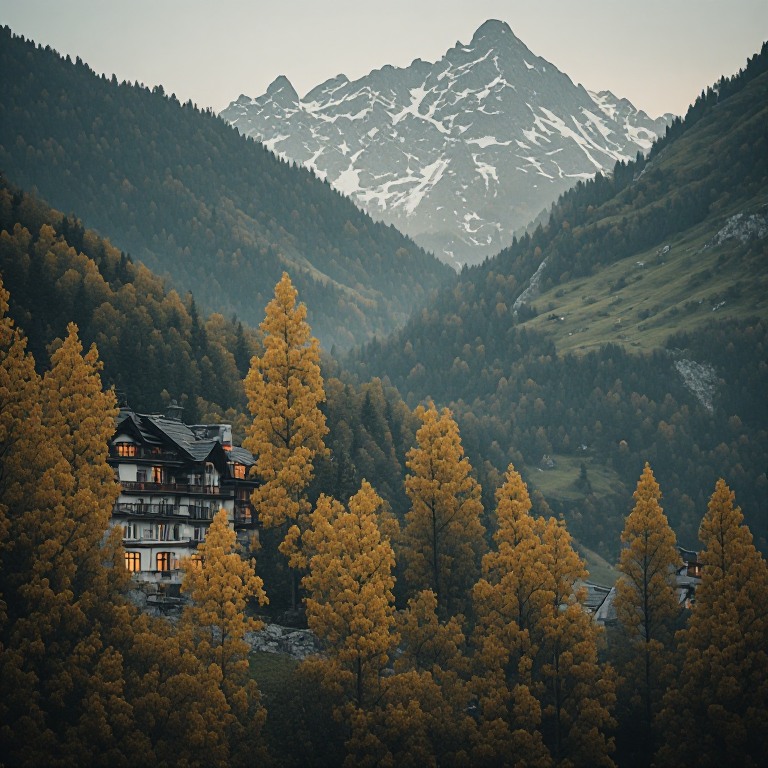
The same principle works in the opposite direction. South Tyrol is particularly interesting in autumn because the region does not simply become a quieter version of its summer self. It changes character. The mountains begin to turn, vineyards enter harvest, light becomes lower and more precise. Walking becomes less about escaping into nature and more about observing it. Food moves toward a different register. Hotels become quieter. The point is not that autumn is “better” than summer. It is that autumn offers something summer cannot. That is increasingly important in luxury travel, where the experienced traveler has little interest in choosing the universally accepted best month. They are looking for the month that suits the experience they actually want. A South Tyrolean hotel in October is therefore not competing with its own July version. It is offering another proposition entirely.
Then there is the Mediterranean September
The Mediterranean may be the clearest example of the change now underway. For decades, July and August were treated almost as unquestionable definitions of the Mediterranean season. But September has become increasingly difficult to describe as a shoulder season. The sea has retained the heat of summer, extreme temperatures begin to moderate, crowds thin. Restaurants and hotels remain active, while the atmosphere becomes noticeably less compressed.
Travel specialists are increasingly reporting September as a major luxury-travel month rather than a fallback for travelers who missed August. Some luxury-villa operators are even reporting unusually strong September demand from high-spending households. And that distinction matters. Because once September becomes a deliberate choice, rather than a compromise, the entire meaning of the season changes. The French Riviera, Greek islands, Puglia, Croatia and the wider Adriatic are particularly exposed to this shift. The question is no longer: How can I avoid August crowds? It becomes: Why would I come in August at all?
The luxury of arriving at the right moment
This is perhaps where luxury travel is heading. Not toward endless availability, but toward better timing. A sophisticated itinerary may deliberately move through different seasons rather than chasing the same climate throughout the year. The Mediterranean in september, South Tyrol in october, Vienna in november, the Alps in january, Lake Como in may, the Greek islands before the full summer arrives. The destination becomes part of a larger calendar rather than a standalone escape. This is a different philosophy from the old luxury bucket list, where destinations were collected almost like watches. The question was once: Where should I go? It is increasingly becoming: When should I be there? That is a much more sophisticated question.
A place that closes has something to protect
There is another reason seasonality is becoming attractive again. Closure creates scarcity. But not the artificial scarcity of invitation-only clubs or limited-edition products, a more natural kind. When a hotel closes for several weeks, a mountain village becomes quiet, or a coastal restaurant disappears until spring, the destination retains a rhythm that is independent of the visitor. It is not permanently waiting for the tourist, that changes the relationship. The traveler becomes a guest in a place that has its own life, rather than a consumer arriving at a product that has been designed to function continuously. For luxury, this distinction is becoming increasingly meaningful. Because the wealthiest traveler does not necessarily need a destination to revolve around them, they may prefer the opposite, they want to enter a world that already exists.
The danger of making every season a season
There is, however, a paradox. As September and October become more popular, the industry will inevitably try to turn them into another peak season. That is already beginning. If every quiet Mediterranean September becomes fully booked, fully priced and fully marketed, the advantage begins to disappear. If every Alpine summer becomes an outdoor-wellness programme, its difference from winter becomes less pronounced. Luxury travel has a tendency to consume the very scarcity that made something desirable. The challenge for destinations will therefore be to extend the season without erasing its identity. That means resisting the temptation to make every month identical. Not every restaurant needs to remain open, not every activity needs to be available, not every hotel needs to operate at maximum intensity all year. Sometimes the absence is part of the product.
The new luxury calendar
Perhaps this is why the most interesting luxury destinations of the coming years will not necessarily be those that remain open longest. They will be those that understand what each season is for. Winter should feel like winter, autumn should have its own vocabulary, summer should not have to apologise for being summer. And the months in between should not be treated simply as discounted versions of something more desirable. The sophisticated traveler is beginning to understand this. They are not necessarily looking for more destinations, they are looking for the right destination at the right moment. And perhaps that is the deeper luxury of a place that closes. It reminds us that time still matters, that some experiences cannot be separated from the season that creates them. And that a destination does not have to be available all the time to remain desirable. Sometimes, its greatest luxury is knowing when to disappear.
